
What Is a Telecom Rating Engine?
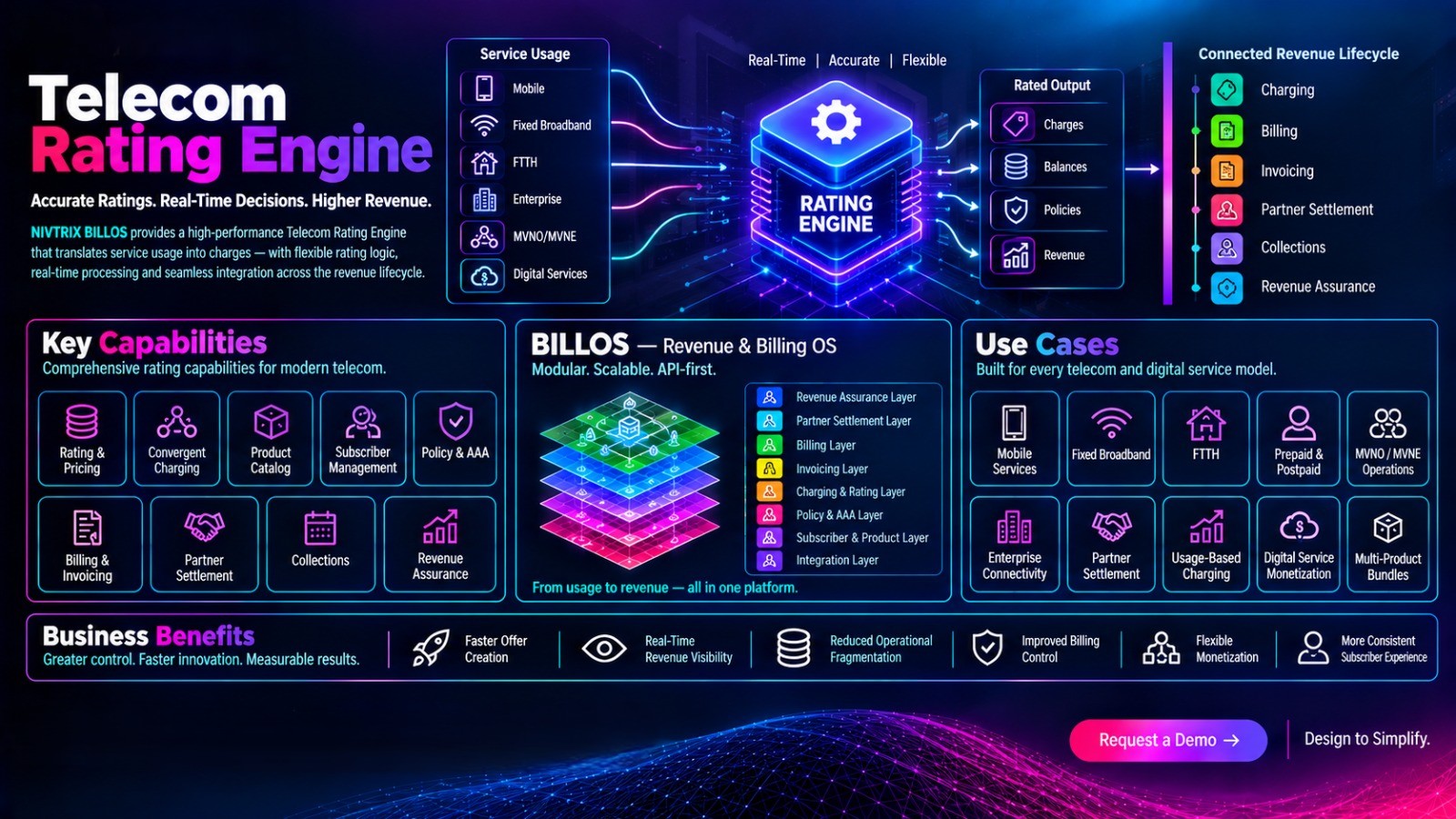
A Telecom Rating Engine determines how telecom usage is translated into charges according to applicable tariffs, plans, products and commercial rules.
As telecom, fintech and enterprise environments become more digital, rating can no longer operate as an isolated billing function. Rating needs to remain connected with charging, billing, invoicing, subscriber management, product catalog, policy and AAA, partner settlement and revenue assurance.
Nivtrix addresses this requirement through BILLOS — Revenue & Billing OS, designed for telecom operators, ISPs, MVNOs, MVNEs and digital service providers.
The objective is to create a connected monetization model that can scale as services, partners, users and network requirements evolve.
Why Telecom Rating Engine Matters
Legacy billing environments can make new product launches slow and create operational gaps between charging, invoicing, customer management and revenue controls.
Modern providers need monetization systems that can support:
- Prepaid services
- Postpaid services
- Hybrid services
- Digital services
- Mobile services
- Fixed broadband
- FTTH
- Enterprise connectivity
- MVNO/MVNE operations
- Usage-based charging
A modern Telecom Rating Engine should provide operational control while remaining flexible enough to work with existing systems.
This is particularly important for organizations modernizing in phases. Open APIs, modular services and workflow automation can introduce new capabilities without requiring every legacy application to be replaced simultaneously.
How Nivtrix BILLOS Supports Telecom Rating
Nivtrix is building modular operating systems across telecom and fintech using an API-first, microservices-based and AI-ready architecture.
Within this portfolio, BILLOS focuses on:
BILLOS Revenue Lifecycle
- Convergent Charging → Rating → Billing → Invoicing → Subscriber Management → Product Catalog → Policy & AAA → Partner Settlement → Collections → Revenue Assurance
BILLOS brings the revenue lifecycle into a modular operating environment. Usage and service events can be rated, balances updated, invoices generated, policies applied and financial workflows connected through APIs.
Operators can deploy the required modules while integrating with existing CRM, OSS, payment and network systems.
Key Capabilities of Telecom Rating Engine
A successful Telecom Rating Engine deployment should combine domain functionality with integration, governance and operational visibility.
1. Rating & Pricing
Apply rating and pricing logic to telecom usage and service events. The rating layer provides the commercial interpretation of usage before downstream charging and billing processes.
2. Convergent Charging
Connect rating with charging across different service and customer models, supporting a common revenue architecture rather than isolated rating environments.
3. Product Catalog
Connect commercial products and service definitions with rating and monetization workflows.
4. Subscriber Management
Maintain the relationship between subscriber information, products, plans and revenue processes.
5. Policy & AAA
Connect authentication, authorization and policy-related controls with the charging and monetization environment.
6. Billing & Invoicing
Extend rating outputs into billing and invoicing workflows.
7. Partner Settlement
Support rating and revenue processes involving commercial partners and interconnected services.
8. Collections
Connect rating and billing-related workflows with downstream collections.
9. Revenue Assurance
Provide greater visibility and control across the revenue lifecycle.
The BILLOS architecture is designed so these modules can be deployed according to business priorities and integrated through APIs.
Telecom Rating Engine Architecture
A logical Telecom Rating Engine workflow can be represented as:
Integration Layer: CRM → OSS/BSS → ERP → Payment Systems → Network Elements → Identity Services → Monitoring → Partner Platforms
Nivtrix's API-first approach keeps domain functions modular, while microservices allow individual capabilities to evolve and scale without forcing every component into the same release cycle.
Telecom Rating Workflow
A connected rating lifecycle can be represented as:
The architecture keeps the relationship between service consumption and commercial value visible across the monetization lifecycle.
For example, a usage event identifies service and subscriber context, applicable rating logic is applied, the charge is calculated, charging and balance context is updated, and the process continues into billing and revenue operations.
Telecom Rating Engine Use Cases
The Nivtrix SEO source identifies the following use cases for Telecom Rating Engine:
Mobile Billing
Apply rating and monetization logic to mobile service usage.
Fixed Broadband
Support rating and billing workflows for fixed broadband services.
FTTH
Connect fiber broadband usage with rating and downstream revenue processes.
Prepaid Services
Support rating for prepaid service models within the broader charging environment.
Postpaid Services
Connect usage rating with billing and invoicing processes.
MVNO/MVNE Operations
Support rating and monetization workflows in virtual operator environments.
Enterprise Connectivity
Apply commercial rating models to enterprise connectivity services.
Partner Settlements
Connect rating information with partner revenue and settlement processes.
Usage-Based Charging
Translate service consumption into applicable charges through defined rating logic.
Digital-Service Monetization
Extend rating capabilities to evolving digital service models.
Business and Operational Benefits
For organizations evaluating a Telecom Rating Engine, technology selection should be linked to measurable outcomes.
Faster Offer Creation
Support changing products and monetization models through modular capabilities.
Real-Time Revenue Visibility
Connect charging and revenue information across operational workflows.
Reduced Operational Fragmentation
Reduce gaps by connecting related monetization workflows.
Improved Billing Control
Maintain stronger relationships between usage, charging and billing.
Flexible Monetization
Support changing service and commercial models through connected rating capabilities.
More Consistent Subscriber Experience
Keep operational data connected across customer and revenue processes.
Because operational data is connected across workflows, organizations can also build dashboards, analytics and automation around customer and operational processes.
Telecom Rating Engine Integration
A rating engine rarely operates independently. Modern telecom environments may exchange information with:
- OSS/BSS
- CRM
- ERP
- Payment systems
- Network elements
- Identity services
- Monitoring platforms
- External partner systems
Nivtrix uses an API-first approach so customers can connect the required ecosystem while keeping domain functions modular.
This supports incremental modernization and allows individual capabilities to evolve without forcing the entire technology environment into the same release cycle.
Technical Architecture for Telecom Rating
The Nivtrix product architecture also documents a rating environment involving:
This provides a technical path from network-generated usage information through mediation and rating toward billing and settlement.
For interconnect environments, the documented architecture includes network elements, CDR collection, Rating Engine and Settlement Engine.
For MVNO environments, Nivtrix also documents Pricing & Rating Engine, Interconnect CDR Processing, Settlement & Reconciliation, Revenue Analytics & Reporting and Real-time Dashboard capabilities.
Why Nivtrix BILLOS?
BILLOS provides a modular Revenue & Billing OS that connects:
Connected Revenue Architecture
- Rating → Charging → Billing → Invoicing → Settlement → Revenue Assurance
The architectural approach is designed around a common rating environment rather than completely independent prepaid and postpaid rating stacks.
Nivtrix's technical architecture also documents online charging, rating and plan management, invoicing and revenue, RADIUS AAA, inventory and captive portal, and sales CRM and commissions within the BILLOS model.
This creates a stronger relationship between commercial rules, usage, charging and billing data.
Built for Integration and Evolution
A Telecom Rating Engine should not force organizations into a complete technology replacement.
Organizations can begin with a focused business requirement, integrate the relevant Nivtrix modules and expand deployment as operational priorities evolve.
Conclusion
A Telecom Rating Engine is a critical part of the telecom monetization chain because it connects service usage with the commercial rules that determine how that usage is valued.
Connected Monetization Model
- Usage → Mediation → Rating → Charging → Billing → Settlement → Revenue Assurance
Nivtrix BILLOS provides a modular foundation for this architecture, connecting rating with charging, billing, subscriber management, product catalog, policy and AAA, partner settlement, collections and revenue assurance.
The objective is to make telecom monetization simpler, faster and more measurable, while allowing organizations to modernize at their own pace.